ONE HUNDRED AND THIRTY FOUR

Melissa Gregg interviews McKenzie Wark in the LA Review of Books on the 10 year anniversary of ‘A Hacker Manifesto.’

“MG: Where does the maker movement fit in relation to hacking’s histories and politics? How do the branded interests served by this trend (e.g. MakeMagazine, 3D printing companies, tech manufacturers) reconfigure the battles for power and property outlined in The Hacker Manifesto

MW: If we take hacking in the cultural sense to be something that emerges out of MIT and similar environments in the middle of the twentieth century, then there’s a certain poetic logic to reconnecting it to everyday, hobbyist kinds of tinkering, which after all was one of its origin stories — the MIT model railways club. Something of the ethos of hacking as another kind of labor, one with some degrees of freedom, which creates its own internal codes of use value, seems to have leaked out into maker culture. The hacker, whether as a professional coder doing her day job, or running a hackspace on the weekend, is someone who one can imagine as still having some shred of a utopian practice. Being good at making something good, within the limits of time and materials. 

But I think what happened in the ten years since I wrote A Hacker Manifestois that we won the battle and lost the war. We won certain affordances for the gift, for social creation, for use value, within the commodification of information. But what I call the vectoral class, the class which owns and controls the mode of information, regrouped around a more abstracted kind of control. So, OK, we can play with our data, but they control the metadata. And it’s based on unequal exchange. We get these little smidgens of data, but we give up more than we get. Surplus data as “business model” rather than surplus value. 

MG: This reminds me of an early line from the manifesto: “We do not own what we produce — it owns us.” I think this is the way many people are starting to feel about data. How does the data economy — surely the ultimate form of power enjoyed by the vectoral class today — extend or challenge the model of property in your book?

MW: Yes, people are still not comfortable with the idea that information is now supposed to be somebody else’s private property. We still think of it as a relation, rather than a thing. Those of us who produce it know this from our everyday experience: a fact or a thought or a feeling emerges out of some activity of relation. That it might then become a thing that someone else, who was not even a part of that activity, owns at our expense… we’re not very happy about that.

It’s even more confusing in that for the most part those who end up owning the product of our intellectual efforts are not all that interested in us anyway. The data is of interest in aggregate, or the users are of interest in aggregate. We and our data are owned for the purposes of selling us on to advertisers or other clients who might make use of that aggregate data. People see the “privacy” side, but they are even more disturbed I think by the opposite: the indifference side. Nobody really cares about your weird sex thing on the internet, other than as a way to sell you products related to your weird sex thing.”

via Biella Coleman.

ONE HUNDRED AND THIRTY ONE

From Whales, by Charlene Kwon in > kill author.

“There are dead whales in the basement and they’re starting to smell. We know, the neighbor knows, even the neighbor’s cousin from Galveston knows. Everyone knows and no one will do a goddamn thing about it.
The cat’s the only one who hasn’t noticed. We envy the cat.
Keeping talk radio on 24 hours a day seems to make the whales smell less. Sometimes we even forget about the dead whales and on days when we feel particularly awesome and horny, we like to host barbeques.
We begin to smoke cigarettes and this helps too.
Four years later the radio station begins to lose money. They keep asking for donations. We listen to their phones ringing. We listen to pledges. We are tired of how much the radio station needs us. We are tired of feeling inadequate because we can’t provide them with what they need. We are tired of the radio station’s deepening dependency. We look to each other for comfort and we only find that we are tired from the stench of dead whales. We light each other’s cigarettes and carry on with our days.”

ONE HUNDRED AND TWENTY NINE

David Sedaris, from Let’s Explore Diabetes with Owls.

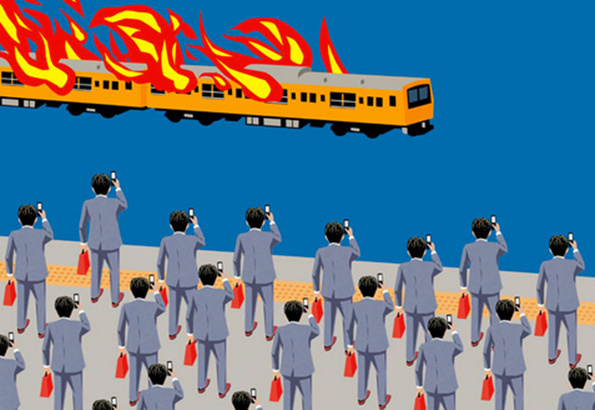
“I’ve become like one of those people I hate, the sort who go to the museum and, instead of looking at the magnificent Brueghel, take a picture of it, reducing it from art to proof. It’s not “Look what Brueghel did, painted this masterpiece” but “Look what I did, went to Rotterdam and stood in front of a Brueghel painting!” 

ONE HUNDRED AND TWENTY FIVE

From White Noise, Don DeLillo, 1985:

I related the circumstances of my presumed exposure.
    “How long were you out there?”
    “Two and a half minutes,” I said. “Is that considered long or short?”
    “Anything that puts you in contact with actual emissions means we have a situation.”
    “Why didn’t the drifting cloud disperse in all that wind and rain?”
    “This is not your everyday cirrus. This is a high-definition event. It is packed with dense concentrations of byproduct. You could almost toss a hook in there and tow it out to sea-, which I’m exaggerating to make a point.”
    “What about people in the car? I had to open the door to get out and get back in. “
    “There are known degrees of exposure. I’d say their situation is they’re minimal risks. It’s the two and a half minutes standing right in it that makes me wince. Actual skin and orifice contact.
    This is Nyodene D. A whole new generation of toxic waste. What we call state of the art. One part per million million can send a rat into a permanent state.”
    He regarded me with the grimly superior air of a combat veteran. Obviously he didn’t think much of people whose complacent and overprotected lives did not allow for encounters with brain-dead rats. I wanted this man on my side. He had access to data. I was prepared to be servile and fawning if it would keep him from dropping casually shattering remarks about my degree of exposure and chances for survival.
    “That’s quite an armband you’ve got there. What does SIMUVAC mean? Sounds important.”
    “Short for simulated evacuation. A new state program they’re still battling over funds for.”
    “But this evacuation isn’t simulated. It’s real.”
    “We know that. But we thought we could use it as a model.”
    “A form of practice? Are you saying you saw a chance to use the real event in order to rehearse the simulation?”
    “We took it right into the streets.”
    “How is it going?” I said.
    “The insertion curve isn’t as smooth as we would like. There’s a probability excess. Plus which we don’t have our victims laid out where we’d want them if this was an actual simulation. In other words we’re forced to take our victims as we find them. We didn’t get a jump on computer traffic. Suddenly it just spilled out, three-dimensionally, all over the landscape. You have to make allowances for the fact that everything we see tonight is real. There’s a lot of polishing we still have to do. But that’s what this exercise is all about.”
    “What about the computers? Is that real data you’re running through the system or is it just practice stuff?”
    “You watch,” he said.
    He spent a fair amount of time tapping on the keys and then studying coded responses on the data screen–a considerably longer time’ it seemed to me, than he’d devoted to the people who’d preceded me in line. In fact I began to feel that others were watching me. I stood with my arms folded, trying to create a picture of an impassive man, someone in line at a hardware store waiting for the girl at the register to ring up his heavy-duty rope. It seemed the only way to neutralize events, to counteract the passage of computerized dots that registered my life and death. Look at no one, reveal nothing, remain still. The genius of the primitive mind is that it can render human helplessness in noble and beautiful ways.
    “You’re generating big numbers,” he said, peering at the screen.
    “I was out there only two and a half minutes. That’s how many seconds?”
    “It’s not just you were out there so many seconds. It’s your whole data profile. I tapped into your history. I’m getting bracketed numbers with pulsing stars.”
    “What does that mean?”
    “You’d rather not know.”
    He made a silencing gesture as if something of particular morbid interest was appearing on the screen. I wondered what he meant when he said he’d tapped into my history. Where was it located exactly? Some state or federal agency, some insurance company or credit firm or medical clearinghouse? What history was he referring to? I’d told him some basic things. Height, weight, childhood diseases. What else did he know? Did he know about my wives, my involvement with Hitler, my dreams and fears?
    He had a skinny neck and jug-handle ears to go with his starved skull–the innocent prewar look of a rural murderer.
    “Am I going to die?”
    “Not as such,” he said.
    “What do you mean?”
    “Not in so many words.”
    “How many words does it take?”
    “It’s not a question of words. It’s a question of years. We’ll know more in fifteen years. In the meantime we definitely have a situation. “
    “What will we know in fifteen years?”
    “If you’re still alive at the time, we’ll know that much more than we do now. Nyodene D. has a life span of thirty years. You’ll have made it halfway through.”
    “I thought it was forty years.”
    “Forty years in the soil. Thirty years in the human body.”
    “So, to outlive this substance, I will have to make it into my eighties. Then I can begin to relax.”
    “Knowing what we know at this time.”
    “But the general consensus seems to be that we don’t know enough at this time to be sure of anything.”
    “Let me answer like so. If I was a rat I wouldn’t want to be anywhere within a two hundred mile radius of the airborne event.”
    “What if you were a human?”
    He looked at me carefully. I stood with my arms folded, staring over his head toward the front door of the barracks. To look at him would be to declare my vulnerability.
    “I wouldn’t worry about what I can’t see or feel,” he said. “I’d go ahead and live my life. Get married, settle down, have kids. There’s no reason you can’t do these things, knowing what we know.”
    “But you said we have a situation.”
    “I didn’t say it. The computer did. The whole system says it. It’s what we call a massive data-base tally. Gladney, J. A. K. I punch in the name, the substance, the exposure time and then I tap into your computer history. Your genetics, your personals, your medicals, your psychologicals, your police-and-hospitals. It comes back pulsing stars. This doesn’t mean anything is going to happen to you as such, at least not today or tomorrow. It just means you are the sum total of your data. No man escapes that.”
    “And this massive so-called tally is not a simulation despite that armband you’re wearing. It is real.”
    “It is real,” he said.

ONE HUNDRED AND TWENTY FOUR

I almost always remember a good part of my dreams, but lately they’ve been particularly strange and vivid. Last night I sailed through a cold marsh from mainland China to Korea in a floppy little boat, with the texture of a silicone oven mit, the size of a canoe and full of backpacking tourists (it took about fifteen minutes and I was back by two thirty in the afternoon). The night before I was in a massive, dimly lit parking garage with a crew of sorority girls playing some frosh game that I didn’t understand. The ground was coated in this sticky sap, and the girls rushed to paste it all over their team jerseys to give them some sort of competitive advantage.

In the 80s, my dad made short experimental films in school; my favourite is a commercial he filmed on Super 8. A man at a party goes looking for a beer, opens a fridge, and is transported to a frigid, desolate wilderness. He wanders through this empty tundra for what feels like hours to the tune of repetitive, hypnotic new wave synthesizer and the film has this funny effect where, just as you’ve completely forgotten how he got there in the first place, he trips on a bottle of beer in the snow and finds himself transported back to the party. It’s clever and feels a bit absurd, and more than once I’ve found myself wandering around the same landscape in my sleep. Sometimes I trip and find an object too, other times I realize I’m in my dad’s film and just feel a little smug.

ONE HUNDRED AND TWENTY TWO

Hiding Among Us, from Richard Seymour:

“Hamas, they tell us, is cowardly and cynical.

Hiding among civilians.

They hid at the el-Wafa hospital.  They hid at the beach, where children played football.  They hid at the yard of 75 year old Muhammad Hamad.  They hid among the residential quarters of Shujaya.  They hid in the home of the poet, Othman Hussein.  They hid in the thousands of houses damaged or destroyed.  They hid in 84 schools and 23 medical facilities.  They hid in a cafe, where Gazans were watching the World Cup.  They hid in the ambulances trying to retrieve the injured.

Masters of disguise, they hid so well that no one ever found them.  They hid themselves in a young woman in pink household slippers, sprawled on the pavement, taken down while fleeing.  They hid themselves in the little boy whose parts were carried away by his father in a plastic shopping bag.  They hid themselves in an elderly woman, lying in a pool of blood on a stone floor.

Hamas, they tell us, is cowardly and cynical.”