ONE HUNDRED AND THREE

Teju Cole on travelling from Amman to Ramallah for the Palestine Festival of Literature.

“Monday

How does one write about this place? Every sentence is open to dispute. Every place name objected to by someone. Every barely stated fact seems familiar already, at once tiresome and necessary. Whatever is written is examined not only for what it includes but for what it leaves out: have we acknowledged the horror of the Holocaust? The perfidy of the Palestinian Authority? The callousness of Hamas? Under these conditions, the dispossessed – I will leave aside all caveats and plainly state that the Palestinians are the dispossessed – have to spend their entire lives negotiating what should not be matters for negotiation at all: freedom of movement, the right to self-determination, equal protection under the law.

The Augusta Victoria Hospital, on Mount Scopus, is one of the better hospitals available to Palestinians. It is easy for those in East Jerusalem to get to. For those living in the West Bank, a permit is needed, and usually one isn’t issued unless there’s urgent need: for radiation therapy, for instance, or dialysis. Dr Tawfiq Nasser, who runs the hospital, tells us about a man from Gaza who had the wrong ID and thus for eight years couldn’t see his son, whose ID was similarly restrictive. The man was diagnosed with cancer and finally got a permit to enter Jerusalem. He went to see his son in the West Bank, spent three weeks with him, came back to the hospital for one week of chemotherapy, and returned to Gaza and died.”

NINETY NINE

From Four Deuces by Stuart Dybek in A Public Space.

“One Saturday I hear the opera station mixed up with the creepy sound of pigeons. Usually, Frank played it quiet cause he knew opera annoyed me. But it’s blaring. I walk to the porch and he’s standing by the windows looking out, waving his arms like he’s Pavarotti. Jumped like I’d caught him in the act. I look out the window to see what he’s singing at. Across the alley, where there used to be Pani Bozak’s chickens pecking at a dirt yard, there’s the Widow’s laundry hanging on a pulley clothesline from her back window. What sun shines back there’s shining through her flimsy black panties. It’s like Frederick’s of Hollywood: lacy slips, camisoles, D-cup bras, nylons—not panty hose—silk nylons like she was wearing when she sashayed into the Deuces, like women used to wear with garter belts. You see underclothes like that and know why they’re called unmentionables. Everything’s black but her bedsheets, these beautiful silk sheets that must of cost a fortune. With every breeze, her panties wave on the line like pennants over a used car lot.

I go, Enjoying the view?”

NINETY SEVEN

Truly, ominous.

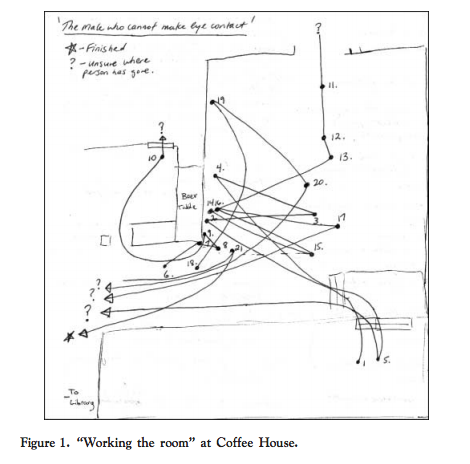
“It is not law firms that are being “branded” here, despite what students think, but the law students themselves, creating an image of class and sophistication that legitimates their status while at the same time it persuades them that this is what “real law”—big city law, big money law—just is. Coffee House provides an opportunity for students to practice, develop, and get used to exercising all those skills of social capital that Bourdieu tells us will be essential components of their future career. On the one hand, then, Coffee House is a rehearsal in the deployment of the tools of social capital. On the other, it is a performance that demonstrates the students’ collective competence to the lawyers who observe it. In each case, the effects on students’ attitudes to law, and to their own futures, is not limited by whether or not they talk to the lawyers who are present, or if instead they “just come to have a drink.” The identity of students, individually and as a body, is being transformed and entrenched physically, subconsciously, and imperceptibly.

Part V places this argument about the power of social conditioning in the wider context of the law school, in which students at McGill, as elsewhere we hasten to add, feel an intense conflict between the pedagogical values of the university and its commitment to professional training. The unease that many of their teachers feel with the profession of law creates enormous anxiety within the student community. We argue that Coffee House is one distinct, if informal, institution that strongly encourages students to feel the difference between their being and their becoming, their present and their future, as a kind of fate into which they are being inexorably drawn. Coffee House helps to construct new identities for law students while it encourages them to think of their legal education as merely a transition, a temporary impediment to the “real world” that Coffee House portrays and foreshadows.”

Manderson, Desmond, and Sarah Turner. “Coffee House: Habitus and Performance Among Law Students.” Law and Social Inquiry 31.3 (2006): 649-76.

Screen Shot 2014-05-30 at 9.52.04 AM

NINETY FOUR

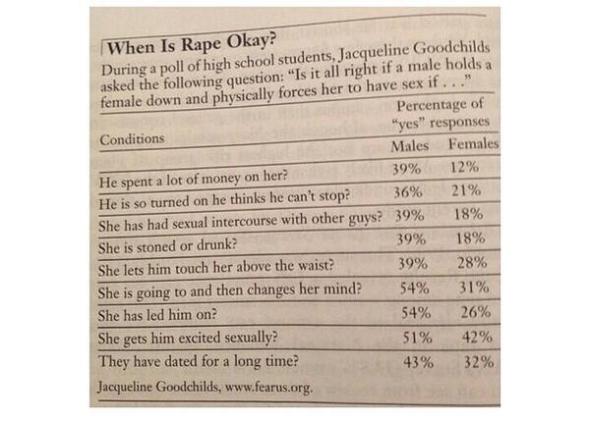
Because I am sick of giving men fake phone numbers, or telling them I have a boyfriend, because I know how easily and violently “I’m not interested” can be ignored.

Because during the year I spent working at the student union, there was a period where I was receiving regular rape and death threats because of my organization’s political position.

Because I was advised against speaking about that experience by other student activists because talking about it might have “derailed” the public conversation about education.

Because I couldn’t go to the police for support because they were too busy arresting, assaulting, and terrorizing students in the street—women, people of colour, and other marginalized groups disproportionately among them.

Because obnoxious, loud, “progressive” white guys are getting what seems like infinitely more airtime talking about violence against women this week than women are. And because white women are getting infinitely more airtime than women of colour or trans women, who are affected to an even greater extent by sexual violence and abuse.

Because I can already imagine the trivializing, derailing, bigoted and threatening text messages and tweets we will receive if I talk about this issue on tomorrow night’s radio show.

Because I was harassed by a man who went so far as to move on to the same street as me, forced to change my route home, screen my emails, avoid campus, and eventually move—but despite fearing for my safety I never spoke publicly because I was worried people would think I was overreacting.

Because I have to worry that expressing earnest rage about any of these things openly will, at best, result in being politely sidelined (“that’s not very constructive”), and at worst professional repercussions, more threats, more violence, and more fear.

Because I am sick of being so fucking scared all the time.

#yesallwomen
#yesallwhitewomen
#cisgaze

Image

NINETY THREE

The Companion, by Maria Tiurina, via Faith is Torment.

NINETY THREE

58e9b2634c9cfb0d324ca045c1eabbce

“I call it “The Companion”. A story about two friends – a girl and her imaginary pet – who traveled for a long time, saw many beautiful places and met a lot of new people, creatures and animals who joined them as their journey continued. They arrived to something that resembles the edge of the world, and at first it might seem that their adventure has come to an end, but the girl is pointing at something high above that we cannot see, showing to her companion that there are more things to discover and enjoy together if only they wish to continue moving forward.”

NINETY TWO

Elliot Rodger and Men Who Hate Men on the Belle Jar:

“We don’t know if Elliot Rodger was mentally ill. We don’t know if he was a “madman.” We do know that he was desperately lonely and unhappy, and that the Men’s Rights Movement convinced him that his loneliness and unhappiness was intentionally caused by women. Because this is what the Men’s Rights Movement does: it spreads misogyny, it spreads violence, and most of all it spreads a sense of entitlement towards women’s bodies. Pretending that this is the a rare act perpetrated by a “crazy” person is disingenuous and also does nothing to address the threat of violence that women face every day. We can’t just write this one off – we need to talk about all of the fucked up parts of our culture, especially the movements that teach men that they have the right to dominate and intimidate and violate women, that lead to this, and we need to change things. Because if we don’t, I guarantee that this will happen again. And again. And again.

‘”Why do men feel threatened by women?” I asked a male friend of mine. So this male friend of mine, who does by the way exist, conveniently entered into the following dialogue. “I mean,” I said, “men are bigger, most of the time, they can run faster, strangle better, and they have on the average a lot more money and power.” “They’re afraid women will laugh at them,” he said. “Undercut their world view.” Then I asked some women students in a quickie poetry seminar I was giving, “Why do women feel threatened by men?” “They’re afraid of being killed,” they said.’

Margaret Atwood, Writing the Male Character (1982)”

EIGHTY NINE

“Ordinary life does not interest me. I seek only the high moments. I am in accord with the surrealists, searching for the marvelous. I want to be a writer who reminds others that these moments exist; I want to prove that there is infinite space, infinite meaning, infinite dimension. But I am not always in what I call a state of grace. I have days of illuminations and fevers. I have days when the music in my head stops. Then I mend socks, prune trees, can fruits, polish furniture. But while I am doing this I feel I am not living.”

Anaïs Nin reads from her diaries, via Maria Popova