SEVENTY TWO

Alive in the Sunshine, Alyssa Battistoni in Jacobin.

“Finding ways to live luxuriously but also lightly, adequately but not ascetically, won’t always be easy. But perhaps in the post-post-scarcity society, somewhere between fears of generalized scarcity and dreams of generalized decadence, we can have the things we never managed to have in the time of supposed abundance: enough for everyone, and time for what we will.”

SIXTY EIGHT

“The standard accusations levied against this generation — about our legendary narcissism, our sense of entitlement, our endless whining — are destructive precisely because they ignore the magnitude of the crises that we face (and unless you grew up during the Great Depression, then no, I’m sorry, you really didn’t have it “just as tough” when you were our age). Perhaps if the middle-class weren’t eroding before our very eyes, or if the economy was actually creating good jobs, or if there were any labor movement at all – or if the super-rich simply hadn’t managed to successfully hijack our democracy and our courts … perhaps then, things would be different. And if, in this idyllic utopia of our hippie-liberal imaginations, millennials were still the whiny, spoiled, entitled brats we’re so frequently portrayed as, accusations about our lack of character might be both fair and accurate.

Unfortunately, we’ll never know. The world we’ve inherited, this plutocratic “free-market” horror show, is crushing millions of young people desperate for work — any work. This is the most obvious reason that millennials seem so prone to “whining.” It’s also why these accusations must stop. This brand of criticism is enormously ignorant and offensive — it trivializes the massive, systemic problems facing this country and this generation. Due to the profligacy and waste of older Americans, the economic problems that young people will face — massive federal debt payments, shrinking research and education budgets, crumbling infrastructure, a fast-changing climate — are crises that have no easy remedy. They’re also essentially ticking time bombs that, if not soon addressed, will wreak enormous destruction on our economy and our ecology for the decades, centuries, perhaps millennia to come.”

Tim Donovan in Salon, “Boomers are humiliating themselves: Why their pandering to millennials is so sad.”

SIXTY SEVEN

“…But the Hebrew word, the word timshel—‘Thou mayest’— that gives a choice. It might be the most important word in the world. That says the way is open. That throws it right back on a man. For if ‘Thou mayest’—it is also true that ‘Thou mayest not.’ Don’t you see?…‘Thou mayest’! Why, that makes a man great, that gives him stature with the gods, for in his weakness and his filth and his murder of his brother he has still the great choice. He can choose his course and fight it through and win.” Lee’s voice was a chant of triumph.
Adam said, “Do you believe that, Lee?”
“Yes, I do. Yes, I do. It is easy out of laziness, out of weakness, to throw oneself into the lap of deity, saying, ‘I couldn’t help it; the way was set.’ But think of the glory of the choice! That makes a man a man. A cat has no choice, a bee must make honey. There’s no godliness there…Confucius tells men how they should live to have good and successful lives. But this—this is a ladder to climb to the stars.” Lee’s eyes shone. “You can never lose that. It cuts the feet from under weakness and cowardliness and laziness…I have no bent toward gods. But I have a new love for that glittering instrument, the human soul. It is a lovely and unique thing in the universe. It is always attacked and never destroyed— because ‘Thou mayest.’”

John Steinbeck, East of Eden, via Katelyn Rowe of The Listserve.

SIXTY SIX

“This great crisis which we witness in our schools is interlinked with a greater social crisis in the community. We seem to have lost our identity. Children and old people are penned up and locked away from the business of the world to a degree without precedent; nobody talks to them anymore, and without children and old people mixing in daily life; a community has no future and no past, only a continuous present. In fact the name “community” hardly applies to the way we interact with each other. We live in networks, not communities, and everyone I know is lonely because of that.”

John Taylor Gatto, in Dumbing Us Down.

SIXTY FIVE

“Why did the chicken cross the road?

It had been crossing so long it could not remember. As it stopped in the middle to look back, a car sped by, spinning it around. Disoriented, the chicken realized it could no longer tell which way it was going. It stands there still.”

Kafka’s Joke Book, John McNamee, McSweeney’s Internet Tendency.

SIXTY

Vonnegut in The Paris Review.

“INTERVIEWER
Not many writers talk about the mechanics of stories.

VONNEGUT
I am such a barbarous technocrat that I believe they can be tinkered with like Model T Fords.

INTERVIEWER
To what end?

VONNEGUT
To give the reader pleasure.

INTERVIEWER
Will you ever write a love story, do you think?

VONNEGUT
Maybe. I lead a loving life. I really do. Even when I’m leading that loving life, though, and it’s going so well, I sometimes find myself thinking, “My goodness, couldn’t we talk about something else for just a little while?” You know what’s really funny?

INTERVIEWER
No.

VONNEGUT
My books are being thrown out of school libraries all over the country—because they’re supposedly obscene. I’ve seen letters to small-town newspapers that put Slaughterhouse Five in the same class with Deep Throat and Hustler magazine. How could anybody masturbate to Slaughterhouse Five?”

FIFTY NINE

Mathieu Murphy-Perron is dead on about last night’s election results and this morning’s reactions.

 “On va continuer” he recited, and then poof, there was nothing. That was the PQ’s campaign: fleeting, frightened, doomed, a shadow of its past self. He eventually pulled it together and offered a “de se battre” but it was far too late. Everybody watching could already tell, this PQ had vanished forevermore into that interstitial space between knowing that they need to need to continue and failing to know what they must continue towards.

I shed no tear in their downfall. My heart goes out to the boomers that were raised alongside the party and who never ever questioned it, as I know they must be terribly sad on this day, but their undying and uncritical loyalty birthed a monster that needed to be slain.

Nor do I even remotely rejoice in the absurd victory of one of the most corrupt political parties in the history of the western world. A party led by a man who resigned from his functions as health minister to immediately work for a lobby group labouring to privatise healthcare. A party that stubbornly incited one of the greatest social unrests in North American history. A party that implements regressive tax reforms like that of the Health Tax that disproportion ally affects women and racialised communities. A party that is enthusiastically committed to the destruction of our natural resources for the smallest pittance of economic gain. A party that is so unaware of Aboriginal rights that they failed to answer a questionnaire by the Femmes Autochthones du Québec. A party that gladly reels in the spoils of the Anglo vote all while offering them nothing in return.

Yet so many of my contacts on Facebook are rejoicing: making jokes about eating pasta, proudly announcing that the movers need no longer whisk them away, cursing off the “separatists” in the most undignified of manners, and general Canadiana chest-thumping.”

FIFTY EIGHT

FIFTY EIGHT

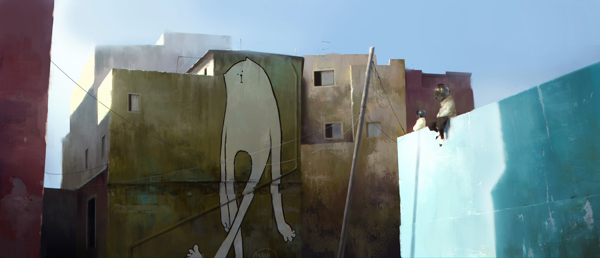
An art installation of a Pakistani child that looks back at Predator drone operators. A beautiful confrontation of the anonymity and detachment of 21st century war.

“According to Foundation for Fundamental Rights, who launched the project, the child in the poster lost both her parents and her two siblings in a drone strike. Now, when drone operators survey the grainy landscape on their computer screens, they’ll see the face of a child victim staring back at them.”