Sally Nixon h/t fp. Feels like Montreal.



Sally Nixon h/t fp. Feels like Montreal.
Timo Kuilder (more on website, some NSFW).
Inside Foxconn via art fag city.
 .
.
I found an excerpt from this piece by Nora Samaran saved in my drafts from a year ago. While I take issue with parts of the article (and specifically the haphazard discussion of attachment theory), this passage still feels important now as I continue to reflect on how to work with the men in my life from a place of compassion and integrity.
Shame and guilt unhealed and unaddressed remain powerful and, like a volcano, rise up in surprising ways. For instance, shame can lead men to shut down and run or blame women or act defensive instead of offering comfort and nurturance when someone they care about needs them. It can, alternately, lead men to ignore signs that someone does not want them close.
These are two sides of the same system, and must be understood together, because in a culture that does not expect men to show up for their own emotions, women get blamed for unaddressed male shame.
In other words, it seems possible that shame and guilt, left subterranean, interrupt attunement, and can lead to an inability or unwillingness to properly respond to the needs of others, whether for nurturance or for space. I mean the really deep, structural kind of shame, that is so old and convincing, it doesn’t even appear as anything in particular. It just appears as ‘the way the world is,’ laid down in patterns in the limbic brain. This kind of shame hides, appears as nothing in particular, until questioned with compassion and curiosity, deeply, in safe company.
via Archillect.

From Alfred Whitehead’s Science and the Modern World.
“Modern science has imposed on humanity the necessity for wandering. Its progressive thought and its progressive technology make the transition through time, from generation to generation, a true migration into uncharted seas of adventure. The very benefit of wandering is that it is dangerous and needs skill to avert evils. We must expect, therefore, that the future will disclose dangers. It is the business of the future to be dangerous ; and it is among the merits of science that it equips the future for its duties.”
From Ellen Ullman:
“We build our computer (systems) the way we build our cities: over time, without a plan, on top of ruins.”
I love this little thought from Alain de Botton.
“At the heart of sulk lies a confusing mixture of intense anger and an equally intense desire not to communicate what one is angry about. The sulker both desperately needs the other person to understand and yet remains utterly committed to doing nothing to help them do so. The very need to explain forms the kernel of the insult: if the partner requires an explanation, he or she is clearly not worth of one. We should add that it is a privilege to be the recipient of a sulk: it means the other person respects and trusts us enough to think we should understand their unspoken hurt. It is one of the odder gifts of love.”
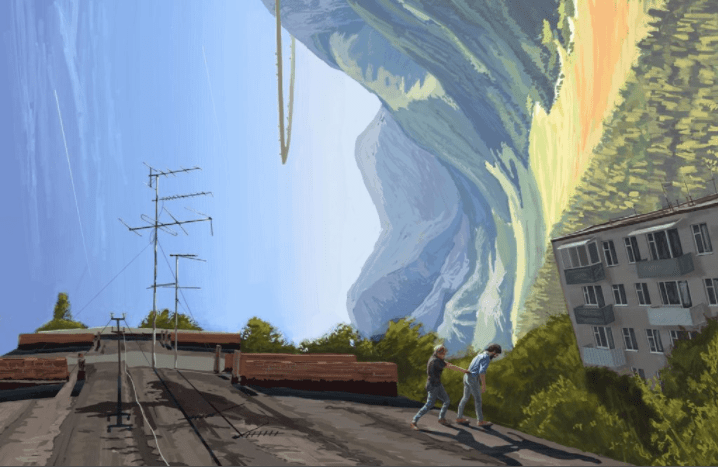
The winners from the Fairy Tales 2017 competition are incredible. From Mykhailo Ponomarenko’s Last Day:

From Underground Airlines by Ben H. Winters.
…Among that crew was a woman named Cherie, who had herself escaped from Louisiana and then dedicated her adult life to the Cause. Most of their work, Cherie liked to say, was done at a desk. Forget the glory of the predawn raid. Smashing in the face of of the system and pulling free the enslaved was mostly a matter of paperwork. The opening of bank accounts, the forging of documents. The creation of routes and backup routes and backups to the backups. “La liberté,” Cherie was fond of saying, in that charming Montreal accent of hers, “est une question de logistique.”
From The Fall, Camus.
“I know what you’re thinking: it’s very hard to disentangle the true from the false is what I’m saying … You see, a person I knew used to divide human beings into three categories: those who prefer having nothing to hide rather than being obliged to lie, those who prefer lying to have nothing to hide, and finally those who like both lying and the hidden. I’ll let you choose the pigeon-hole that suits me.
But what do I care? Don’t lies eventually lead to the truth? And don’t all my stories, true or false, tend toward the same conclusion? Don’t they all have the same meaning? So what does it matter whether they are true or false if, in both cases, they are significant of what I have been and of what I am? Sometimes it is easier to see clearly into the liar than into the man who tells the truth. Truth, like light, blinds. Falsehood, on the contrary, is a beautiful twilight that enhances every object.”







 lexgill.com