SEVENTEEN

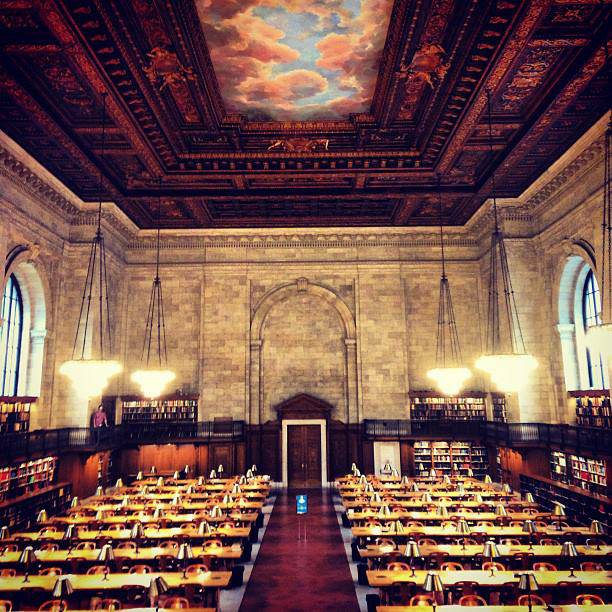
When I work from New York, I spend all day writing at the library on 5th (it’s where I am right now!) so that I can meet my partner, who works in Times Square, for lunch. There’s something about working from the study halls that lets me just read and write for hours without feeling distracted (which is a good thing because I’m so swamped with work).

I feel immensely calm and productive here; it’s just about my favourite space in the city. When I look up at the ceiling, I wonder if I’m the only person who remembers that 90’s Macaulay Culkin film where the main character learns about courage through an animated adventure. I can imagine the ceiling dripping down and melting all over (image via Pinterest).
994593_10151797112697351_1424059726_n

I also can’t help but hear the Ghostbusters theme song every once in a while…a little like this.

SIXTEEN

From the Dictionary of Obscure Sorrows, one definition less hopeful:

kuebiko

n. a state of exhaustion inspired by acts of senseless violence, which force you to revise your image of what can happen in this world—mending the fences of your expectations, weeding out all unwelcome and invasive truths, cultivating the perennial good that’s buried under the surface, and propping yourself up like an old scarecrow, who’s bursting at the seams but powerless to do anything but stand there and watch.

and another a little more hopeful:

la gaudière

n. the glint of goodness inside people, which you can only find by sloshing them back and forth in your mind until everything dark and gray and common falls away, leaving behind a constellation at the bottom of the pan—a rare element trapped in exposed bedrock, washed there by a storm somewhere upstream.

and a third one, full of recognition and truth (surely the most famous, and for good reason):

sonder

n. the realization that each random passerby is living a life as vivid and complex as your own—populated with their own ambitions, friends, routines, worries and inherited craziness—an epic story that continues invisibly around you like an anthill sprawling deep underground, with elaborate passageways to thousands of other lives that you’ll never know existed, in which you might appear only once, as an extra sipping coffee in the background, as a blur of traffic passing on the highway, as a lighted window at dusk.

and my favourite:

liberosis

n. the desire to care less about things—to loosen your grip on your life, to stop glancing behind you every few steps, afraid that someone will snatch it from you before you reach the end zone—rather to hold your life loosely and playfully, like a volleyball, keeping it in the air, with only quick fleeting interventions, bouncing freely in the hands of trusted friends, always in play.

THIRTEEN

Today I dealt with just the most absurd series of bureaucratic interactions—at the post office, at the university, at the bank. It was massively exhausting (and to top it off I got a flat tire!). After a morning like that, then six hours of an intensive grad class on feminist approaches in CED, I felt pretty exhausted by the time I got to NDG for a meeting.

We had to get together to do a bit of planning for MTL SOUP, and no matter how tired I was, I’m glad I went. The event is going to be amazing: intimate, democratic, thoughtful, nourishing, lightweight community building at its best. 

It’s really energizing to be building a new community project from the ground up with such amazing people. There’s a sense that if the launch is a success, there’s a lot of opportunity for growth, and there’s already so much support from the wider community. We’re trying to do things properly from the very beginning: linking to what’s already good in the city, using the resources that already exist, and building a messy little web of excuses for already great organizations to work more closely (and enjoy a meal) together. It’s why we’re cooking vegan from scratch, using reusable dishes, borrowing from faith organizations, insisting on a democratic process, bringing in local musicians, and hosting in a multidisciplinary student art space.

It’s really liberating to do something so simple and lighthearted right from start to finish. 

TWELVE

A week or two ago, Gonzo and I took turns reading aloud from Dumbing Us Down — a collection of John Taylor Gatto’s speeches. His ideas have been following me around since, and I shared this quote (from “The Psychopathic School”) during my talk at a BCGEU conference this past weekend.

“This great crisis which we witness in our schools is interlinked with a greater social crisis in the community. We seem to have lost our identity. Children and old people are penned up and locked away from the business of the world to a degree without precedent; nobody talks to them anymore, and without children and old people mixing in daily life; a community has no future and no past, only a continuous present. In fact the name “community” hardly applies to the way we interact with each other. We live in networks, not communities, and everyone I know is lonely because of that.”  (Dumbing Us Down)

Fantastically important questions arise from this — as community organizers, how to we build inter-generational strength and collective identity? How do we mitigate the alienating (and profoundly individualizing) affect of institutions on children and adults alike? What is the relationship between loneliness and social change, between loneliness and apathy?

(As I write this I happen to be working from the New York Public Library, where NBC is hosting “Education Nation,” a summit which (at least from the frantic crowds I see going in and out of the conference doors) appears completely devoid of any children whatsoever.)

ELEVEN

Last night I was riding my bicycle home from NDG and was feeling a bit sad that it’s getting to be too cold to ride for much longer. I guess I’ve always known how to ride a bike: my mom never knew how but my aunt taught me in parking lots when I was a kid (for which I am eternally grateful). Learning to ride a bike in the city felt like learning all over again though: the traffic, distractions, other cyclists, angry motorists and bike lane politics make it entirely unlike the traffic-calmed residential areas I rode in as a child. There’s an imperative to be a bit fearless and ballsy (especially in a city like Montreal) lest you get door’d or end up in someone’s blind spot at the wrong moment. With some serious patience from my gentleman-friend, I went from being incredibly anxious and timid to being a pretty serious fixie rider with a huge amount of nerve and awesome legs.

I’ve been working on expressing gratitude more lately, and I think learning to bike (properly) in the city is one of the things I feel most grateful for in the past few years. It’s given me such an incredible sense of freedom and autonomy, trust in my body, and certainty in my own judgement. It has changed the way I see and experience my city, and made me feel a huge sense of ownership and belonging in the street that I never had before. More than getting me out of the miserable underground system or giving me a new way to take care of my body, cycling has also given me an excuse to enjoy solitude. TIme that used to feel wasted in transit is all of a sudden mine to spend wondering and daydreaming, as a chance to decompress or to shake off anxiety. It has become an enormously therapeutic, meaningful thing in my life—maybe the way some people feel about yoga—and some of my best ideas lately have happened on two wheels. 

This is my bike, and today I’m feeling really grateful about it.

Image

Nine

McSweeney’s Internet Tendency makes me giggle. From Our Killer Appears to be a Millennial:

“So we start creating content that feels authentically shareable—vines, photos, longreads, whatever. It’s all gotta speak to his interests as an always-on, social-focused doer/maker who might work as a barista during the day but spends his evenings following his true passion of DIY electronics.

Sure, I know, then we have a bunch of content, but how the hell is that gonna nab us the most vicious serial killer seen in our metro area since the 1970s? Simple: we aggregate all of this content in an immersive, media-rich microsite.”

Five

Today I found a photo collection from Jon Crispin of abandoned suitcases discovered at the Willard Asylum for the Chronic Insane. Crispin talks about having to obfuscate the identities of their owners:

“Here’s a weird story: When I do the shooting, my digital photographs are labeled with what’s called IPTC information. It’s all the camera metadata stored with each photo, and you can add whatever you want. I typically add my copyright information, and also the names of the Willard patients for my own records. But when I upload photos to my blog, I strip that out.

For one person’s suitcase, I forgot to delete their name. Two days later, I got a call from someone who’s desperate, saying, “Do you have the objects of —?” and she gave the name of the person. And she said, “That is my grandmother. We didn’t know anything about her.” She had Googled her grandmother’s name and came across the Willard suitcases on my site. But even in this situation, the woman had to prove to the state that she was not only the granddaughter of this person, but that she was legally the recipient of her estate. So, in other words, if the grandmother had willed her estate to the other side of the family, this woman would not have been able to get access to her things.”

[…] I’m still trying to figure out how I can name these people, because I think it dehumanizes them even more not to. People who’ve been in mental institutions themselves have said, “Your project is very moving to me, but I’m very disappointed that you have to obscure names.”

20120518103

Four

“…Before I go on with this short history, let me make a general observation — the test of a first-rate intelligence is the ability to hold two opposed ideas in the mind at the same time, and still retain the ability to function. One should, for example, be able to see that things are hopeless and yet be determined to make them otherwise. This philosophy fitted on to my early adult life, when I saw the improbable, the implausible, often the “impossible,” come true. Life was something you dominated if you were any good. Life yielded easily to intelligence and effort, or to what proportion could be mustered of both.”

From “The Crack Up,” F. Scott Fitzgerald, Esquire, 1936