TWO HUNDRED AND ELEVEN

Thinking about surveillance and poverty today. From Michele Estrin Gilman‘s “The Class Differential in Privacy Law.”

“John Castiglione argues that dignity is an equally important Fourth Amendment value as privacy. As he points out, under the reasonableness standard’s balancing test, it is almost impossible for an individual’s “abstract, indeterminate” privacy interest to outweigh the state’s concrete interest in law enforcement and social control. Accordingly, he posits that dignity can support the scaffolding of the Fourth Amendment in a way that privacy cannot. He notes, people (such as prisoners) can completely lack privacy but still claim “a legitimate expectation of being treated with dignity.” In philosophical terms, dignity is the “right to be treated as an end, not as a means.” In practical terms, it is the opposite of “unnecessarily degrading, humiliating, or dehumanizing government behavior.” In legal terms, the Supreme Court often uses the concept of dignity to inform constitutional interpretation, so it is recognized as a constitutional commitment even if rarely enforced in the Fourth Amendment context. Castiglione helpfully contrasts privacy, which protects access to the self, with dignity, which “generally concerns a limitation on the manner in which an individual is interacted with.” Under his proposal, government searches and seizures would be unlawful if they degrade or humiliate individuals without a sufficient countervailing law enforcement interest.”

TWO HUNDRED AND NINE

From How to Construct a Time Machine, at MK Gallery. (via happyfamousartists).

The show’s title is taken from an 1899 text by the avant-garde French writer, Alfred Jarry, written in direct response to H. G. Wells’ science fiction novel The Time Machine (1895). Wells invented and popularised a distinctively modern, fictional concept of time travel, with the time machine as a vehicle that could be operated ‘selectively’.Jarry’s response crafted a pseudo-scientific fiction that presents the time machine and time travel as an instance of ‘the science of imaginary solutions.’

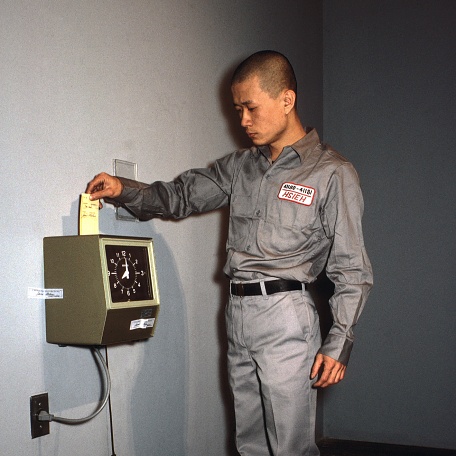
th-oneyearperformance1980-1981punchingthetimeclockphotomichaelshen1980

Tehching Hseih: One Year Performance, 1980 – 1981, Punching theTime Clock. Photo: Michael Shen, 1980.

Kris-Martin

100 Years by Kris Martin (“A sleek bronze sculpture, size of a football ball, that also acts as a time bomb. It is set by Martin to detonate in 2104.”)

TWO HUNDRED AND SEVEN

Brené Brown, The Courage to be Vulnerable.

“But to separate that from the reality of vulnerability, I always ask a very simple question to people. I just say think of the last time you did something that you thought was really brave or the last time you saw someone do something really brave. You know, I think, without question — and I can tell you as a researcher, 11,000 pieces of data, I cannot find a single example of courage, moral courage, spiritual courage, leadership courage, relational courage, I cannot find a single example of courage in my research that was not born completely of vulnerability. And so I think we buy into some mythology about vulnerability being weakness and being gullibility and being frailty because it gives us permission not to do it.”

TWO HUNDRED AND FIVE

From Mirror Worlds: or the Day Software Puts the Universe in a Shoebox, via Farnam Street.

When an expert remembers a patient, he doesn’t remember a mere list of words. He remembers an experience, a whole galaxy of related perceptions. No doubt he remembers certain words—perhaps a name, a diagnosis, maybe some others. But he also remembers what the patient looked like, sounded like; how the encounter made him feel (confident, confused?) … Clearly these unrecorded perceptions have tremendous information content. People can revisit their experiences, examine their stored perceptions in retrospect. In reducing a “memory” to mere words, and a quick-march parade step of attribute, value, attribute, value at that, we are giving up a great deal. We are reducing a vast mountaintop panorama to a grainy little black-and-white photograph.

There is, too, a huge distance between simulated remembering—pulling cases out of the database—and the real thing. To a human being, an experience means a set of coherent sensations, which are wrapped up and sent back to the storeroom for later recollection. Remembering is the reverse: A set of coherent sensations is trundled out of storage and replayed—those archived sensations are re-experienced. The experience is less vivid on tape (so to speak) than it was in person, and portions of the original may be smudged or completely missing, but nonetheless—the Rememberer gets, in essence, another dose of the original experience. For human beings, in other words, remembering isn’t merely retrieving, it is re-experiencing.

And this fact is important, because it obviously impinges (probably in a large way) on how people do their remembering. Why do you “choose” to recall something? Well for one thing, certain memories
make you feel good. The original experience included a “feeling good” sensation, and so the tape has “feel good” recorded on it, and when you recall the memory—you feel good. And likewise, one reason you choose (or unconsciously decide) not to recall certain memories is that they have “feel bad” recorded on them, and so remembering them makes you feel bad. (If you don’t believe me check with Freud, who based the better part of a profoundly significant career on this observation, more or less.) It’s obvious that the emotions recorded in a memory have at least something to do with steering your solitary rambles through Memory Woods.

But obviously, the software version of remembering has no emotional compass. To some extent, that’s good: Software won’t suppress, repress or forget some illuminating case because (say) it made a complete fool of itself when the case was first presented. Objectivity is powerful.

On the other hand, we are brushing up here against a limitation that has a distinctly fundamental look. We want our Mirror Worlds to “remember” intelligently—to draw just the right precedent or two from a huge database. But human beings draw on reason and emotion when they perform all acts of remembering. An emotion can be a concise, nuanced shorthand for a whole tangle of facts and perceptions that you never bothered to sort out. How did you feel on your first day at work or school, your child’s second birthday, last year’s first snowfall? Later you might remember that scene; you might be reminded merely by the fact that you now feel the same as you did then. Why do you feel the same? If you think carefully, perhaps you can trace down the objective similarities between the two experiences. But their emotional resemblance was your original clue. And it’s quite plausible that “expertise” works this way also, at least occasionally: I’m reminded of a past case not because of any objective similarity, but rather because I now feel the same as I did then.

TWO HUNDRED AND FOUR

Product Review: The Invisible Backpack of White Privilege from L.L. Bean, by Joyce Miller.

“The Invisible Backpack of White Privilege is great for carrying questionable things like weed, Ponzi schemes, and sex crimes. I have lived in dense urban areas my whole life, and the cops never once search my Invisible Backpack. Then again, that’s probably just because, like people always tell me, I have a really trustworthy vibe as a person.

My roommate Sam has a visible backpack from The North Face, which he says cost him so much that he and his family are still paying for it, whatever that means. Personally, I prefer function over trend. Sam had the nerve to suggest that if I were to trade my backpack for his backpack, I’d see what he means. I told him if he’s really that dissatisfied with his own backpack, he should just return it to the store and buy one like mine instead of criticizing me all the time, because from what I can see, my backpack’s only advantage is that it comes with a more positive attitude and frugal spending habit than all the other backpacks. He got really quiet and things between us have grown uncomfortable.”

TWO HUNDRED AND ONE

From Joseph Alfred v. Walt Disney Co.

This matter is before me on the Defendants’ motions to dismiss a complaint sounding in contract, filed by the Plaintiff, Mr. Alfred, pro se. That Complaint is remarkable. It is in my experience a unique example of the pleader’s art. It cites to the epic of Gilgamesh, Woody Guthrie, the Declaration of Independence, Noah and The Great Flood, Game of Thrones, Star Wars Episode V: The Empire Strikes Back, Star Trek, President Obama, and Euclid’s proof of the Infinity of Primes, among other references. It is well-written and compelling. In fact, it can be faulted only for a single—but significant—shortcoming: it fails to state a claim on which relief could be granted. Therefore, I grant the Defendants’ Motions to Dismiss.

The Plaintiff, in succinct and pith-perfect fashion, stated the gravamen of his action as follows: “If the Plaintiff needed to sum up this entire case in one sentence, it is this: Two executives of the Disney Company are stalling the next evolution of human transportation on this planet.”

In other words, the Defendants are holding back the flying car.

TWO HUNDRED

From Beautiful Decay on McCharen and Chromat’s Bionic Bodies.

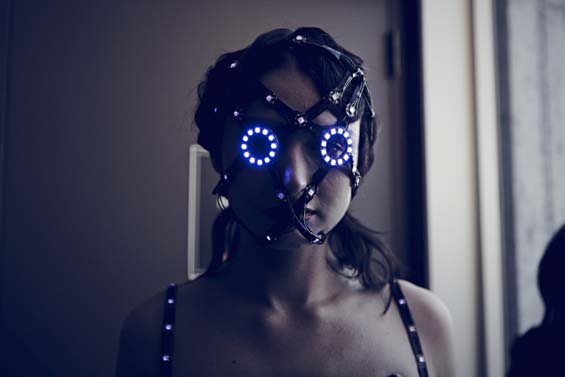
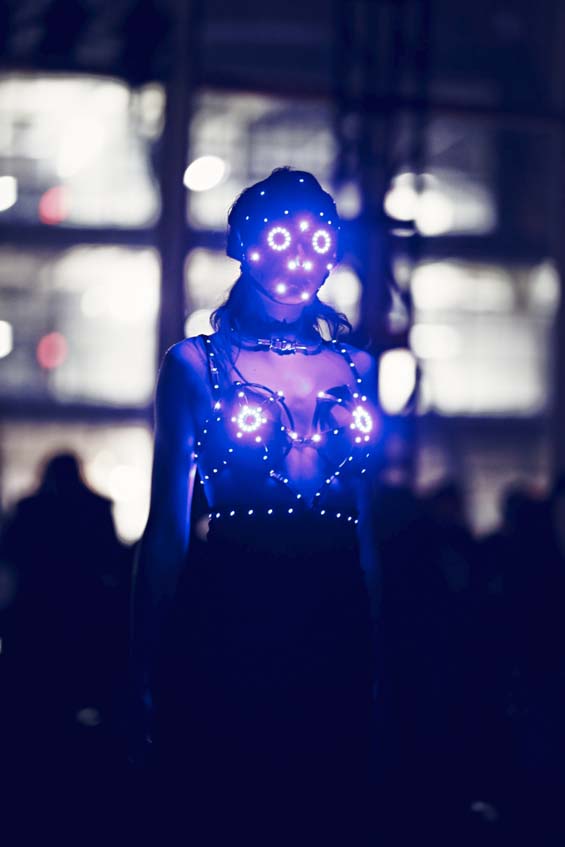
“Their new line was called Bionic Bodies, inspired by a love story McCharen envisioned between a human and a robot. The result? Bodies scaffolded like bionic arms and exoskeletons, chromed ribcages studded at the seams, and, most strikingly, faces and bras illuminated with blue LEDs. When the lights are off, the cyborg effect of the LEDs is eerily sexy; have a look at Chromat’s runway video above and see for yourself.

What McCharen and the Chromat crew are creating is more than just experiments in fashion and architecture — their work is fascinating from a theoretical perspective, as well. Absorbed in our daily experiences and emotional lives, we forget that we are, in fact, bones wrapped in muscle and flesh, propelling ourselves through space by the miracle of physics. By engineering such structures on the outside of the body, Chromat celebrates such functionality and mechanical perfection. The parallel between structural facades and fashion is interesting, as well, if we understand fashion as a way to construct our identities and shift the way people interact with us. Like the exterior of powerful structures, Chromat’s revolutionary works exude strength, self-assurance, and impermeability — hence the eerie power and unsusceptible beauty of McCharen’s cyborgs.”

CHROMAT_MG_9093

CHROMAT_99A0762

ONE HUNDRED AND NINETY SEVEN

Omid Safi: 9 points to ponder on the Paris shooting and Charlie Hebdo.

Let us hope that it is not merely the freedom of speech that we hold sacred, but the freedom to live a meaningful life, though others find it problematic. Let us hope that the freedom to speak, to pray, to dress as we wish, to have food in our stomach and to have a roof over our head, to live free of the menace of violence, the freedom to be human are seen as intimately intertwined… Yes, let us cherish and stand up for the dignity of the freedom of speech. And let us always remember that speech, like religion, is always embodied by human beings. And in order to honor freedom of speech, we need to honor the dignity of human beings.